


CES continues to serve as the annual kickoff for how the adtech community thinks about the year ahead. Overall, this year’s conference centered on AI-led discovery, automated optimization and the merging of content and commerce.
A few major takeaways: Video surfaces will become more shoppable, social platforms will reduce manual setup, search will move toward conversational recommendation and programmatic systems will adopt agent-led workflows. The common thread is a move toward systems that reduce friction between intent and outcome. (If I had to pick one to be slightly skeptical of, it’s the “shoppable video” hype, where the promise has never truly come to fruition — but maybe 2026 will be the year?)
With AI everywhere at CES for the second year running, the industry continues to work on a path where AI handles execution and differentiation depends on the quality of creative, data and measurement.
CES 2026 takeaway No. 1: AI might (finally) help make “shoppable video” a reality
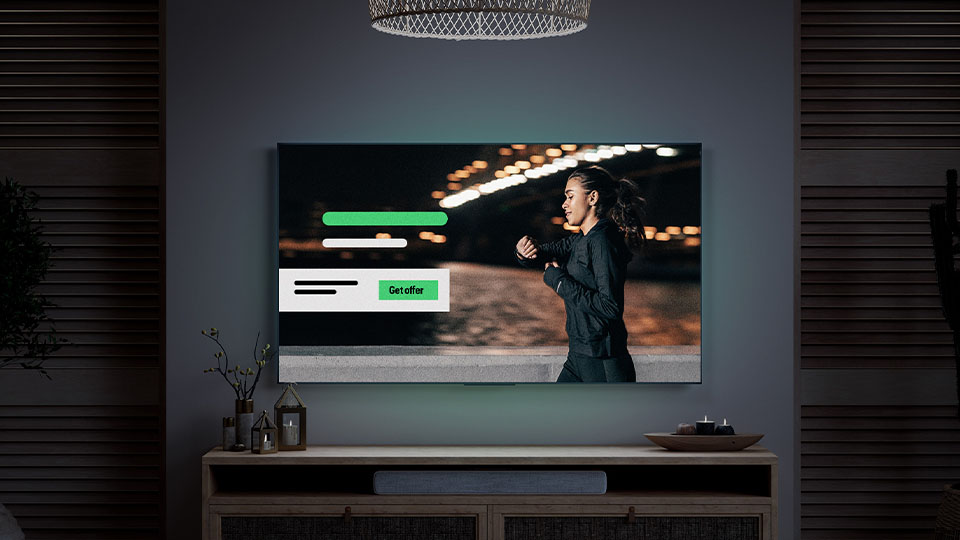
Video platforms are aligning around AI-driven discovery, personalized navigation and commerce-enabled viewing. The TV screen is being repositioned as a place where content, recommendations and product actions coexist.
Client implication: Creative needs to be modular and built for environments where viewers can act immediately. We should assume more interactive inventory and more commerce-adjacent placements.
Major players in this space that made headlines at CES:
Google TV
- Google is shifting Google TV toward AI-led navigation, using models to surface content and products without relying on keyword-based search.
- The platform is adding shopping prompts tied to what viewers are watching, creating direct paths from viewing to product exploration.
- New ad formats are designed for interaction on the TV screen, expanding beyond standard video placements.
- Google is tightening continuity between TV and mobile so discovery can start on one device and finish on another.
Learn more: “Google introduces new Gemini for Google TV features” (from Google’s “The Keyword” blog)
Disney
- Disney is consolidating reporting and benchmarks into Brand Portal, a new interface within Disney Compass that centralizes performance insights.
- The company is expanding first-party audience activation across streaming, linear, digital and sports environments.
- AI is being applied to campaign optimization and creative generation, including tools for producing CTV-ready video assets.
Disney+ is testing vertical video and extended ad formats to increase engagement and inventory flexibility.
Learn more: “Disney Unveils New Solutions Powering Its Advertising Ecosystem at Sixth Annual Global Tech & Data Showcase” (The Walt Disney Company announcement)
Pinterest x Roku
A somewhat unexpected partnership, but given that Pinterest acquired tvScientific in December, this should have been in the tea leaves.
- Pinterest is extending its discovery model to the TV by linking Pins to shoppable actions within Roku’s environment.
- Viewers can move directly from inspiration to product details or carting while watching curated CTV content.
- The integration brings Pinterest’s visual discovery behavior into a lean-back setting where purchase intent can be captured earlier.
Learn more: “Pinterest Shoppable CTV Series Turns Pins Into Purchases on Roku” (Adweek)
Roku
- Roku expects AI-generated content to reach commercial viability quickly, citing falling production costs and improved generative tools.
- The platform continues to scale, now reaching over half of broadband households and handling a significant share of streaming activity.
- Roku is applying AI to improve recommendations, targeting and operational efficiency across its ad stack.
- The company is expanding its footprint with Howdy, a low-cost ad-free service positioned as an accessible alternative to premium streamers.
Learn more: “Roku CEO Talks New $3/Month Ad-Free Streamer, Predicts First ‘100% AI-Generated Hit Movie’ Will Be Released in Next Three Years” (Variety)
DirectTV
- DirecTV is making its linear TV feed available for programmatic digital out-of-home, allowing buyers to place live content in OOH environments.
- The approach merges broadcast signals with location-based targeting, enabling more precise placement of live TV moments.
- Advertisers can synchronize messaging across TV, mobile and OOH to reinforce reach and recall.
Learn more: “DirecTV Launches Dedicated Out-of-Home Ad Network” (TV Tech)
CES 2026 takeaway No. 2: Social platforms are focused on optimizing campaign execution
Social platforms are moving toward systems that translate advertiser intent into automated delivery. Manual setup is being replaced by models that handle targeting, creative variation and budget distribution.
Client implication: The operational focus shifts from manual configuration to supplying strong creative inputs and clear objectives. Platforms will increasingly optimize the rest.
Reddit’s announcement at CES is of particular interest:
- Reddit’s Max Campaigns can now use AI to manage targeting, placements, creative selection and budget allocation with minimal manual tuning (a workflow currently in beta testing).
- Early testing shows meaningful efficiency gains, with lower costs and stronger engagement relative to traditional setups.
- The platform is adding creative tools that generate headlines, thumbnails and (soon) video crops to streamline production.
- Top Audience Personas, a new reporting feature, provides a structured view of which interest clusters are responding to campaigns and why.
Further reading: “Now in Beta: Max Campaigns for AI-Powered Ad Performance and Unique Audience Insights” (Reddit announcement)
CES 2026 takeaway No. 3: Commerce search will increasingly be conversational, not keyword-based
Commerce search is shifting from keyword-based retrieval to conversational recommendation. Retailers are turning AI assistants into monetizable intent surfaces where product suggestions double as ad inventory.
Client implication: Product data and structured content become critical inputs, as assistants increasingly surface a single recommended option rather than a list. AI optimization will be as much about what you do on a retailer’s platform as what you do on the open web.
What Walmart announced at CES:
- Walmart is introducing ads into Sparky, its AI shopping assistant, turning conversational queries into a new discovery surface.
- A large share of users already relies on Sparky for product checks, making it a high-intent environment for sponsored prompts.
- The move positions Walmart alongside Amazon in the emerging category of agentic commerce.
- Walmart Connect is adding Marty, an AI tool that helps advertisers manage bids, keywords and share-of-voice diagnostics.
Learn more: “Walmart Opens Up Ads in Gen AI Shopping Agent Sparky” (Adweek)
CES 2026 takeaway No. 4: Display and programmatic advertising are getting even more automated
Programmatic platforms are moving toward agent-led execution, where systems identify issues, adjust pacing and optimize delivery with limited human intervention. The workflow becomes oversight rather than manual tuning.
Client implication: We should all prepare for a shift toward focusing on stronger governance, ensuring that data, creative and constraints are well defined so autonomous systems can operate effectively and not incinerate budgets.
Key CES announcements include:
Yahoo!
- Yahoo is embedding agentic capabilities directly into its DSP, enabling automated planning, activation and optimization.
- The platform supports external or native agents through a flexible integration model.
- Early examples show agents handling trafficking and troubleshooting tasks that previously required manual effort.
Further reading: “Yahoo DSP Advances Its Buying Platform With New Agentic AI Capabilities” (Yahoo announcement)
PubMatic
- PubMatic is launching AgenticOS, an operating system designed for agent-to-agent programmatic buying across premium inventory.
- The system is being tested with agencies and partners already experimenting with autonomous workflows.
- The focus is on enabling automated negotiation and execution rather than incremental optimization.
Further reading: “PubMatic Launches AgenticOS, the Operating System for Agent-to-Agent Advertising” (PubMatic announcement)
Index Exchange
- Index Exchange is adding show-level reporting using Gracenote data, giving buyers more granular insight into streaming content.
- The feature provides contextual and suitability controls without requiring activation against Gracenote segments.
- Early adoption from publishers indicates demand for more transparent program-level signals.
Further reading: “Index Exchange launches Gracenote-powered show-level reporting with Spectrum Reach” (Gracenote announcement)